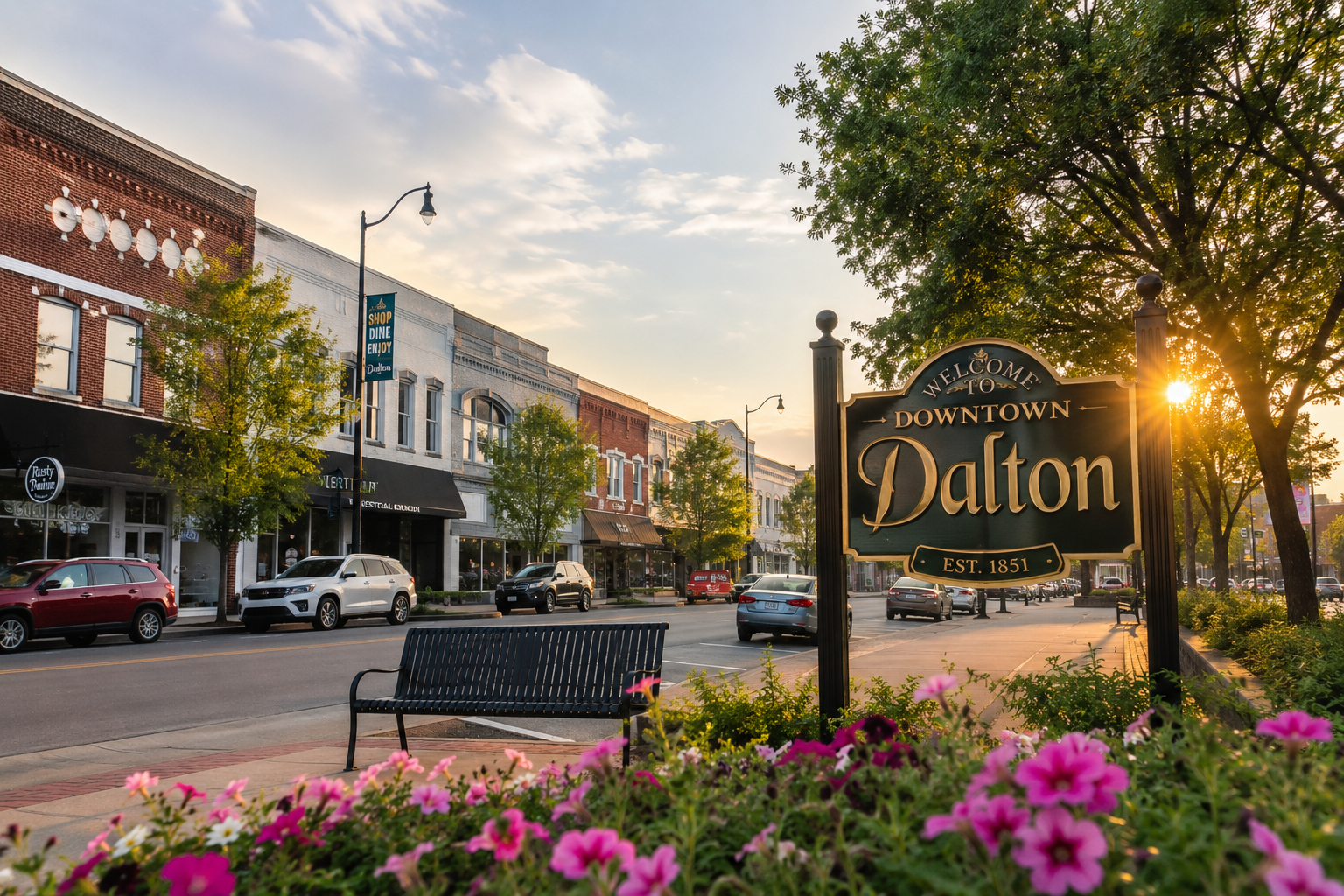
Dalton, Georgia may be one of Northwest Georgia’s easiest cities to underestimate.
Most people know Dalton for one thing: carpet. And yes, the flooring industry is a huge part of this city’s history and economy. But if you are thinking about moving to Dalton, buying a home here, or simply trying to understand this corner of North Georgia, there is a lot more happening than that old nickname suggests.
Dalton sits in the Appalachian foothills along Interstate 75, roughly 25 miles south of Chattanooga and 85 miles north of Atlanta. You can have mountains and trails close to home, reach Chattanooga without making a major production out of it, and still have Atlanta within reach when you need a major airport, event or big-city amenity.
And Dalton itself is changing. New housing initiatives are underway, downtown has seen continued investment, manufacturing has expanded beyond flooring, and outdoor recreation is surprisingly easy to find.
I’m Starla Trainor with Bridle & Bay | Real Broker LLC, and I spend a lot of time looking at North Georgia through the eyes of people who may actually want to live here—not just visit it. So let’s look at Dalton that way.
First: Where Exactly Is Dalton, Georgia?
Dalton is the county seat of Whitfield County in Northwest Georgia. Interstate 75 runs right through the area, and that location is one of Dalton’s biggest practical advantages.
About 25 miles south of Chattanooga
About 85 miles north of Atlanta
About 30 miles from Chattanooga Metropolitan Airport
About 90–100 miles from Hartsfield-Jackson Atlanta International Airport
That does not mean Dalton is an Atlanta suburb. It isn’t. What it does mean is that you are positioned between two much larger metro areas while living in a smaller Northwest Georgia city.
For someone relocating to North Georgia, that distinction matters. You can live outside the daily pace of Atlanta while still having access to it, and Chattanooga is considerably closer for shopping, dining, healthcare, entertainment and air travel.
Dalton Is Changing—and That’s Part of the Story
Calling Dalton simply the “Carpet Capital of the World” no longer tells the whole economic story.
Flooring is still enormously important. Shaw Industries, Mohawk Industries and Engineered Floors remain among the area’s largest manufacturing employers. But Dalton’s employment base also includes healthcare, education, automotive-related manufacturing and solar manufacturing.
Qcells, for example, has become one of the area’s major manufacturing employers. As of August 2026, the Dalton-Whitfield Joint Development Authority lists approximately 1,800 Qcells employees locally, alongside thousands employed by the area’s established flooring manufacturers.
Housing is changing too. In 2026, Believe Greater Dalton reported that the local Land Bank Authority had been reactivated to help address long-vacant and tax-delinquent properties, a zoning amendment had opened the door for additional housing options, and nine homes were in final design for Dalton’s first Cottage Court demonstration project.
Those projects don’t transform a city overnight. But they are worth knowing about if you’re evaluating Dalton for the long term because they show that housing supply, redevelopment and neighborhood investment are active local conversations—not afterthoughts.
What Do Homes Cost in Dalton?
As of August 2026, the latest available housing numbers give us a useful snapshot of Dalton, but this is where numbers can get confusing because different housing websites measure different things.
Redfin reported a Dalton median sale price of approximately $262,000 for the three months ending June 2026. Zillow, using its own Home Value Index rather than simply the median price of homes sold, reported a typical Dalton home value of approximately $241,453 as of July 31, 2026.
Those numbers are not contradictory. One measures recent sales; the other estimates typical home values across the market.
More important for a buyer: a citywide number cannot tell you what a particular house is worth. Dalton has older homes, newer construction, renovated properties, homes needing updates, larger lots, smaller lots and properties outside the city that can feel very different from one another.
I recently toured a 3-bedroom, 2-bath brick home in Dalton listed at $257,000. Rather than looking at listing photos alone, you can walk through the entire house with me and see the layout, condition, lot and space for yourself.

Featured property was offered at $257,000 at the time of filming. Listing courtesy of Tracy Spence | eXp Realty. Listing status, price and availability may change.
One home never defines an entire market, but seeing a real property near Dalton’s recent citywide housing figures gives those numbers some context. From here, the bigger question is what everyday life in Dalton actually looks like.
What Is There to Do Around Dalton?
If your mental picture of Dalton is interstate exits and flooring warehouses, you’re missing quite a bit.
Downtown Dalton has restaurants, shops, public art and Burr Performing Arts Park, an outdoor downtown venue used for concerts and community events.
For outdoor time, Haig Mill Lake Park offers a lake, walking and biking trails, fishing piers, a boating dock for paddle craft, a playground and picnic space. If you want more elevation, the Dalton area also has access to trails around Rocky Face Ridge, including the steep George W. Disney Trail.
The Creative Arts Guild, founded in 1963, brings visual arts, dance, music and exhibits into the community. History is easy to find too. Nearby Tunnel Hill has the Historic Western & Atlantic Railroad Tunnel, and Prater’s Mill dates to 1855 and hosts its well-known annual country fair.
In other words, Dalton isn’t trying to be Atlanta or Chattanooga. That’s part of the point. It has its own downtown, parks, history and community events while putting both mountains and larger-city amenities within reach.
The Part of Dalton That Matters on a Tuesday
When you’re relocating, tourist attractions are nice. Everyday convenience matters more.
Dalton is large enough to have the things most people use routinely—grocery stores, restaurants, retail, medical services, parks and recreation—without requiring a drive into Chattanooga for every errand. The U.S. Census Bureau reported an average commute of about 17.5 minutes for Dalton workers in its 2020–2024 data.
Then there is I-75. If your life regularly takes you north toward Chattanooga or south toward Atlanta, Dalton’s location can make sense in a way that becomes much clearer once you actually put it on a map.
Don’t Search Dalton by City Limits Alone
This is one of the biggest things I would tell someone relocating here.
If you search only for homes with a Dalton city address—or assume every property around Dalton offers the same lifestyle—you can miss a lot.
Northwest Georgia changes quickly as you move outside its city centers. Around Dalton, you’ll find larger lots, acreage, rural residential property, farms and equestrian properties. Someone wanting a house close to everyday conveniences may search very differently from someone wanting room for a barn, horses, a garden or simply more distance between neighbors.
That’s why I prefer starting with how you want to live and then drawing the search area around that, rather than choosing a ZIP code first and trying to force your life into it.
So, Is Dalton Worth Considering?
Yes—if you’re exploring Northwest Georgia, Dalton is absolutely worth putting on your list.
It gives you a smaller-city home base between Chattanooga and Atlanta, a significant local employment base, access to outdoor recreation, an active downtown, and a housing market with options across multiple price points and property types.
But there isn’t one version of “living in Dalton.” A house near downtown, a brick ranch in an established neighborhood, a newer subdivision home and acreage outside town can produce completely different experiences while all appearing in a Dalton-area search.
That’s what makes seeing the area—and seeing actual homes—so valuable.
You don’t need to know exactly where you want to live yet. Tell me what you want your everyday life to look like, what kind of property you want, and what matters most. We can work outward from there.
Starla Trainor, Broker Associate | REALTOR®
Bridle & Bay | Real Broker LLC
Licensed in Georgia, Alabama & Florida
20+ Years in Mortgage Finance, Negotiation & Sales
Residential • Equestrian • Land • Lifestyle
Equal Housing Opportunity
Frequently Asked Questions About Dalton, Georgia
Where is Dalton, Georgia?
Dalton is in Whitfield County in Northwest Georgia along Interstate 75. It is approximately 25 miles south of Chattanooga and 85 miles north of Atlanta.
What is the median home price in Dalton?
Redfin reported a median sale price of approximately $262,000 for the three months ending June 2026. Zillow reported a typical home value of approximately $241,453 as of July 31, 2026. These figures use different methodologies and will change as the market changes.
How far is Dalton from Chattanooga?
Dalton is approximately 25 miles south of Chattanooga. Actual drive time depends on your starting point, destination and traffic.
How far is Dalton from Atlanta?
Dalton is approximately 85 miles north of Atlanta. Hartsfield-Jackson Atlanta International Airport is roughly 90–100 miles from the Dalton area depending on route and starting point.
What is Dalton known for?
Dalton is internationally known for the flooring industry and is commonly called the Carpet or Floor Covering Capital of the World. Today its economy also includes solar manufacturing, automotive-related manufacturing, healthcare, education and other industries.
Are there outdoor things to do in Dalton?
Yes. Local options include Haig Mill Lake Park, Dalton’s city park system and trails in the Rocky Face Ridge area. The surrounding Northwest Georgia region adds considerably more hiking and outdoor recreation within driving distance.
Real Estate Disclosure: This article is provided for general informational purposes and is not intended as legal, tax, financial or lending advice. Real estate information, pricing, availability, commute times, amenities and market conditions may change and should be independently verified. References to locations, amenities and property types are descriptive only and are not intended to indicate or imply the demographic composition or suitability of any neighborhood for any person or protected class.
Starla Trainor, Broker Associate | REALTOR® | Bridle & Bay | Real Broker LLC | Licensed in Georgia, Alabama & Florida | Equal Housing Opportunity.